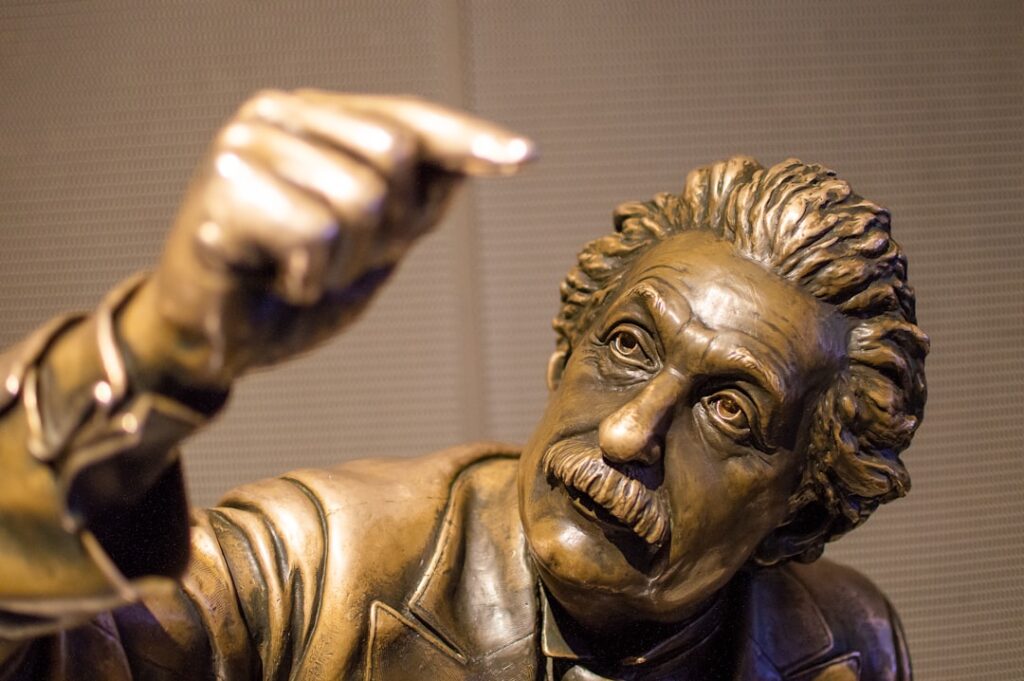
Albert Einstein was born on March 14, 1879, in Ulm, in the Kingdom of Württemberg in the German Empire. His family was secular Jewish, and his father, Hermann Einstein, was a salesman and engineer, while his mother, Pauline Koch, was a homemaker. The family moved to Munich shortly after his birth, where Hermann and his brother founded an electrical engineering company.
From a young age, Einstein exhibited a profound curiosity about the world around him. He was particularly fascinated by mathematics and physics, often pondering complex problems that would later become central to his scientific career. Einstein’s early education was somewhat unconventional.
He struggled with the rigid structure of the German educational system, which emphasized rote memorization over creative thinking. At the age of five, he was introduced to a compass by his father, which sparked a lifelong interest in understanding the forces of nature. Despite his struggles in school, he excelled in mathematics and physics.
In 1894, the family moved to Pavia, Italy, due to financial difficulties, and it was during this time that Einstein decided to leave school and pursue his education independently. He later enrolled at the Polytechnic Institute in Zurich, where he studied physics and mathematics. His time at the institute was marked by both academic challenges and personal growth, as he developed friendships with fellow students who shared his passion for science.
Key Takeaways
- Albert Einstein was born in Ulm, in the Kingdom of Württemberg in the German Empire, on 14 March 1879.
- In 1905, often referred to as his “miracle year,” Einstein published four groundbreaking papers that revolutionized the field of physics.
- Einstein’s theory of relativity, including the famous equation E=mc^2, transformed our understanding of space, time, and energy.
- Einstein was awarded the Nobel Prize in Physics in 1921 for his explanation of the photoelectric effect, not for his theory of relativity.
- Einstein’s personal life was marked by multiple marriages and relationships, as well as a close bond with his two sons.
The Miracle Year
The year 1905 is often referred to as Einstein’s “Miracle Year,” a period during which he published four groundbreaking papers that would fundamentally alter the course of modern physics. Each of these papers addressed different aspects of physical theory and showcased Einstein’s innovative thinking. The first paper introduced the concept of the photoelectric effect, demonstrating that light could be understood as both a wave and a particle.
This work would later earn him the Nobel Prize in Physics in 1921 and laid the groundwork for quantum theory. In addition to the photoelectric effect, Einstein’s second paper presented his theory of Brownian motion, providing empirical evidence for the existence of atoms and molecules. This work not only validated the kinetic theory of heat but also offered insights into the behavior of particles suspended in fluids.
His third paper introduced the special theory of relativity, which revolutionized the understanding of space and time by asserting that they are interwoven into a single continuum known as spacetime. The fourth paper dealt with mass-energy equivalence, encapsulated in the famous equation E=mc². Collectively, these papers established Einstein as a leading figure in theoretical physics and set the stage for future developments in the field.
The Theory of Relativity

Einstein’s special theory of relativity, published in 1905, fundamentally changed how scientists understood the relationship between space and time. Prior to this theory, classical mechanics, as formulated by Isaac Newton, dominated scientific thought. However, Einstein’s insights revealed that time is not an absolute entity but rather relative to the observer’s state of motion.
This radical idea challenged long-held beliefs and introduced concepts such as time dilation and length contraction. The implications of special relativity were profound. For instance, as an object approaches the speed of light, time appears to slow down for that object relative to a stationary observer.
This phenomenon has been experimentally confirmed through various experiments involving atomic clocks on fast-moving jets or satellites. Furthermore, Einstein’s work on relativity led to a deeper understanding of gravity and its effects on spacetime, culminating in his general theory of relativity published in 1915. This theory posited that massive objects like planets and stars warp the fabric of spacetime around them, causing other objects to follow curved paths—a concept that has been confirmed through numerous observations, including the bending of light around massive celestial bodies.
Nobel Prize and Later Years
In 1921, Albert Einstein was awarded the Nobel Prize in Physics for his explanation of the photoelectric effect rather than for his more famous theories of relativity. The Nobel Committee recognized that his work on the photoelectric effect provided crucial evidence for quantum theory and had significant implications for understanding light’s dual nature. This recognition solidified Einstein’s status as one of the foremost scientists of his time and brought him international fame.
He held various academic positions across Europe and eventually settled in Berlin in 1914. However, with the rise of the Nazi regime in Germany during the 1930s, Einstein’s Jewish heritage made him a target for persecution.
In 1933, he emigrated to the United States, where he accepted a position at the Institute for Advanced Study in Princeton, New Jersey. During these later years, he focused on unifying physics theories and delved into philosophical questions about science and its implications for humanity.
Personal Life and Relationships
Einstein’s personal life was marked by complexity and change. He married Mileva Marić in 1903, a fellow student from Zurich who shared his passion for science. The couple had three children: Hans Albert, Eduard, and Lieserl.
However, their marriage faced significant challenges due to Einstein’s growing fame and their differing aspirations. By 1919, they divorced amicably, with Mileva receiving financial support from Einstein for their children. In 1919, shortly after his divorce from Mileva, Einstein married his cousin Elsa Löwenthal.
Elsa played a crucial role in managing Einstein’s public persona and personal affairs during a time when he was becoming increasingly recognized worldwide. Their relationship provided him with stability amid the pressures of fame; however, it was not without its own challenges. Elsa’s health deteriorated over time, and she passed away in 1936.
Throughout his life, Einstein maintained close relationships with several prominent figures in science and philosophy, including Niels Bohr and Max Planck. His friendships often revolved around intellectual discussions that shaped his views on science and society.
Political Activism
Einstein was not only a brilliant physicist but also an outspoken advocate for social justice and political causes throughout his life. His experiences as a Jewish man living in Europe during times of rising anti-Semitism deeply influenced his political views. He became an active supporter of civil rights movements and spoke out against racism and discrimination in various forms.
In the United States, he aligned himself with organizations such as the NAACP (National Association for the Advancement of Colored People) and worked closely with African American civil rights leaders like W.E.Du Bois. Einstein’s political activism extended beyond civil rights; he was also a vocal critic of militarism and war. He famously expressed his opposition to World War I and later became an advocate for nuclear disarmament following World War
His letter to President Franklin D. Roosevelt in 1939 warned about the potential development of atomic weapons by Nazi Germany and urged the U.S. government to initiate its own research into nuclear fission—a letter that ultimately led to the Manhattan Project.
Despite this initial involvement in nuclear research, Einstein later expressed regret over the use of atomic bombs on Hiroshima and Nagasaki and became an ardent proponent of peace.
Legacy and Impact
Albert Einstein’s legacy is vast and multifaceted, extending far beyond his contributions to theoretical physics. His theories have fundamentally altered our understanding of space, time, energy, and matter—concepts that continue to shape scientific inquiry today. The principles established by Einstein have paved the way for advancements in various fields such as cosmology, quantum mechanics, and even technology like GPS systems that rely on relativistic corrections.
Moreover, Einstein’s impact transcends science; he has become an enduring symbol of intellectual curiosity and creativity. His image is often invoked in discussions about genius and innovation across disciplines. Educational institutions worldwide celebrate his contributions by incorporating his theories into curricula while also emphasizing critical thinking skills inspired by his approach to problem-solving.
Additionally, Einstein’s commitment to humanitarian causes has inspired generations of scientists and activists alike to engage with social issues critically.
Einstein’s Lasting Influence
The influence of Albert Einstein continues to resonate across multiple domains even decades after his death on April 18, 1955. His work laid foundational principles that have driven scientific exploration into areas such as black holes, gravitational waves, and quantum entanglement—topics that remain at the forefront of contemporary research today. The ongoing quest to unify general relativity with quantum mechanics reflects Einstein’s enduring legacy as scientists strive to answer questions he posed over a century ago.
Beyond physics, Einstein’s philosophical musings on science have sparked discussions about ethics in scientific research and technology’s role in society. His thoughts on pacifism, civil rights, and social justice remain relevant as contemporary issues continue to challenge humanity globally. As we navigate complex moral dilemmas arising from advancements in artificial intelligence or genetic engineering, Einstein’s advocacy for ethical responsibility serves as a guiding principle for scientists today.
His life story serves as an inspiration for aspiring scientists who seek not only knowledge but also a deeper connection between their work and its implications for humanity at large. Through these various lenses—scientific achievement, social activism, philosophical inquiry—Einstein’s influence remains profound and multifaceted; it continues to inspire new generations to explore the mysteries of existence while advocating for a more just world.
In addition to Walter Isaacson’s insightful biography, “The Life of Albert Einstein,” readers may find the article on the impact of Einstein’s theories on modern physics particularly enlightening. This article delves into how Einstein’s groundbreaking work continues to influence contemporary scientific thought and research. For more information, you can read the article [here](https://hellread.com/2024/12/04/hello-world/).
FAQs
Who was Albert Einstein?
Albert Einstein was a German-born theoretical physicist who is best known for developing the theory of relativity, which revolutionized our understanding of space, time, and gravity. He is considered one of the most influential scientists of the 20th century.
What were Albert Einstein’s major contributions to science?
Einstein’s major contributions to science include the theory of relativity, the famous equation E=mc^2, and his work on the photoelectric effect, which laid the foundation for the development of quantum theory.
What is the theory of relativity?
The theory of relativity, developed by Albert Einstein, consists of two main ideas: the theory of special relativity, which deals with the relationship between space and time, and the theory of general relativity, which describes the force of gravity as a curvature of space-time.
What is E=mc^2?
E=mc^2 is the famous equation derived by Albert Einstein in his theory of special relativity. It states that energy (E) is equal to mass (m) times the speed of light (c) squared, showing the equivalence of mass and energy.
What was Albert Einstein’s personal life like?
Albert Einstein was known for his unconventional personal life, including multiple marriages and a nonconformist attitude. He was also a pacifist and a humanitarian, advocating for civil rights and nuclear disarmament.
What is Walter Isaacson’s book “The Life of Albert Einstein” about?
Walter Isaacson’s book “The Life of Albert Einstein” is a comprehensive biography that delves into Einstein’s personal and professional life, exploring his scientific achievements, his relationships, and his impact on the world.