
Albert Einstein was born on March 14, 1879, in Ulm, Kingdom of Württemberg, German Empire. He came from a secular Jewish family; his father Hermann Einstein worked as a salesman and engineer, while his mother Pauline Koch was a homemaker. The family relocated to Munich shortly after his birth, where Hermann and his brother Jakob established an electrical engineering company.
Einstein demonstrated exceptional curiosity from an early age, particularly in science and mathematics, contemplating complex problems that would later form the basis of his revolutionary theories. Einstein’s educational journey combined formal schooling with independent study. He attended the Luitpold Gymnasium in Munich, where he found the rigid educational approach emphasizing memorization rather than creative thinking to be restrictive.
This educational environment limited his intellectual development and caused him to feel disconnected from classmates and instructors. Nevertheless, he found intellectual stimulation in physics and mathematics books, studying works by scientists like Isaac Newton and James Clerk Maxwell. At 16, Einstein attempted but failed the entrance examination for the Swiss Federal Polytechnic in Zurich.
He subsequently enrolled in a secondary school in Aarau, Switzerland, where he flourished in the more progressive academic setting.
Key Takeaways
- Einstein’s groundbreaking work in 1905 revolutionized physics and introduced the theory of relativity.
- He received the Nobel Prize for his contributions to theoretical physics, particularly the photoelectric effect.
- Beyond science, Einstein was active in political causes and advocated for peace and civil rights.
- His exile during the rise of Nazism shaped his later life and amplified his global influence.
- Einstein’s scientific and philosophical ideas continue to impact culture, science, and society worldwide.
The Miracle Year of 1905
The year 1905 is often referred to as Einstein’s “miracle year,” during which he published four groundbreaking papers that would revolutionize the field of physics. Working as a patent examiner at the Swiss Patent Office in Bern, Einstein had ample time to contemplate complex scientific ideas while reviewing patent applications. In March of that year, he published his paper on the photoelectric effect, which proposed that light could be thought of as discrete packets of energy called photons.
This work would later earn him the Nobel Prize in Physics in 1921 and laid the groundwork for quantum theory. In addition to the photoelectric effect, Einstein’s other significant contributions in 1905 included his special theory of relativity, which introduced the famous equation E=mc², establishing the equivalence of mass and energy. He also published a paper on Brownian motion, providing empirical evidence for the existence of atoms and molecules.
Furthermore, he explored the concept of simultaneity in his paper on the electrodynamics of moving bodies. Collectively, these works not only transformed theoretical physics but also challenged existing paradigms, prompting scientists to rethink fundamental concepts about space, time, and energy.
The Theory of Relativity
Einstein’s theory of relativity fundamentally altered our understanding of space and time. The special theory of relativity, published in 1905, posited that the laws of physics are the same for all observers regardless of their relative motion. This principle led to the conclusion that time is not an absolute entity but is relative to the observer’s frame of reference.
One of the most famous implications of this theory is time dilation, which suggests that time moves slower for objects moving at high speeds compared to those at rest. In 1915, Einstein expanded upon his earlier work with the general theory of relativity, which introduced a revolutionary concept: gravity is not merely a force but a curvature of spacetime caused by mass. This idea was illustrated through the analogy of a heavy object placed on a rubber sheet, causing it to warp.
The implications of general relativity were profound; it predicted phenomena such as gravitational waves and black holes, which would later be confirmed through experimental evidence. The theory not only reshaped theoretical physics but also had practical applications in technologies such as GPS systems, which must account for relativistic effects to provide accurate positioning data.
Nobel Prize and Later Career
In 1921, Albert Einstein was awarded the Nobel Prize in Physics for his explanation of the photoelectric effect rather than for his more famous theories of relativity. The Nobel Committee recognized that while relativity had garnered significant attention and debate within scientific circles, it was Einstein’s work on the photoelectric effect that provided concrete evidence for quantum theory—a field that was still in its infancy at the time. This recognition solidified Einstein’s status as one of the leading physicists of his era and brought him international fame.
Following his Nobel Prize win, Einstein continued to contribute to various fields within physics and mathematics. He held several prestigious academic positions across Europe and eventually accepted a position at the Institute for Advanced Study in Princeton, New Jersey, in 1933. During this period, he focused on unifying the fundamental forces of nature and sought to develop a theory that would encompass both gravity and electromagnetism.
Despite facing challenges in this endeavor, Einstein remained an influential figure in theoretical physics until his death in 1955.
Personal Life and Relationships
Einstein’s personal life was marked by complexity and change. He married Mileva Marić in 1903, a fellow student from his time at the Polytechnic Institute. Their marriage produced three children: Hans Albert, Eduard, and Lieserl.
However, their relationship deteriorated over time due to personal differences and professional pressures. Mileva struggled with her own ambitions as a physicist while supporting Einstein’s burgeoning career. The couple eventually divorced in 1919.
Einstein’s second marriage to Elsa Löwenthal brought him companionship and stability during tumultuous times. Elsa was not only his wife but also his cousin; they shared a close bond that provided emotional support throughout Einstein’s later years. Together they navigated the challenges posed by Einstein’s fame and political activism during World War II and beyond.
Despite his public persona as a genius scientist, Einstein often grappled with feelings of isolation and vulnerability in his personal life.
Political Activism

Einstein was not only a scientist but also an outspoken advocate for social justice and political change. His experiences as a Jewish intellectual in Europe during rising anti-Semitism profoundly shaped his views on civil rights and human dignity. He became increasingly involved in political activism throughout his life, advocating for pacifism during World War I and later opposing fascism and totalitarian regimes during World War
In addition to his pacifist stance, Einstein was an ardent supporter of civil rights for African Americans in the United States. He formed friendships with prominent civil rights leaders such as W.E.Du Bois and Paul Robeson and used his platform to speak out against racial discrimination. In 1946, he famously stated that “racism is a disease of white people,” highlighting his commitment to social justice issues beyond scientific inquiry.
Exile and Legacy
As World War II loomed on the horizon, Einstein faced increasing persecution due to his Jewish heritage and outspoken political views. In 1933, Adolf Hitler came to power in Germany, prompting Einstein to flee to the United States where he accepted a position at Princeton University. His exile marked a significant turning point not only in his life but also in the scientific community as many Jewish scientists faced similar fates.
Einstein’s legacy extends far beyond his scientific contributions; he became a symbol of intellectual freedom and humanitarian values. His advocacy for peace and social justice resonated with many during turbulent times, making him an enduring figure in both science and politics. Even after his death in 1955, Einstein’s ideas continued to inspire generations of scientists and activists alike.
Einstein’s Scientific Impact
Einstein’s contributions to science are immeasurable; he fundamentally changed our understanding of physics through his theories of relativity and quantum mechanics. His work laid the groundwork for modern physics by challenging classical notions of space and time while introducing revolutionary concepts such as mass-energy equivalence and spacetime curvature. The implications of Einstein’s theories extend into various fields beyond physics; they have influenced cosmology, astrophysics, and even technology development such as nuclear energy and GPS systems.
His ability to conceptualize complex ideas has inspired countless scientists to explore new frontiers in research while fostering interdisciplinary collaboration across diverse scientific domains.
Einstein’s Philosophical Views
Einstein’s philosophical outlook was deeply intertwined with his scientific pursuits; he often reflected on the nature of reality and knowledge through a philosophical lens. He believed that science should strive for simplicity and elegance while acknowledging its limitations in fully comprehending the universe’s complexities. His views on determinism versus free will also sparked considerable debate among philosophers and scientists alike.
While he maintained a deterministic perspective rooted in classical physics—believing that every event has a cause—he grappled with the implications of quantum mechanics that introduced elements of randomness into physical phenomena.
Einstein’s Influence on Popular Culture
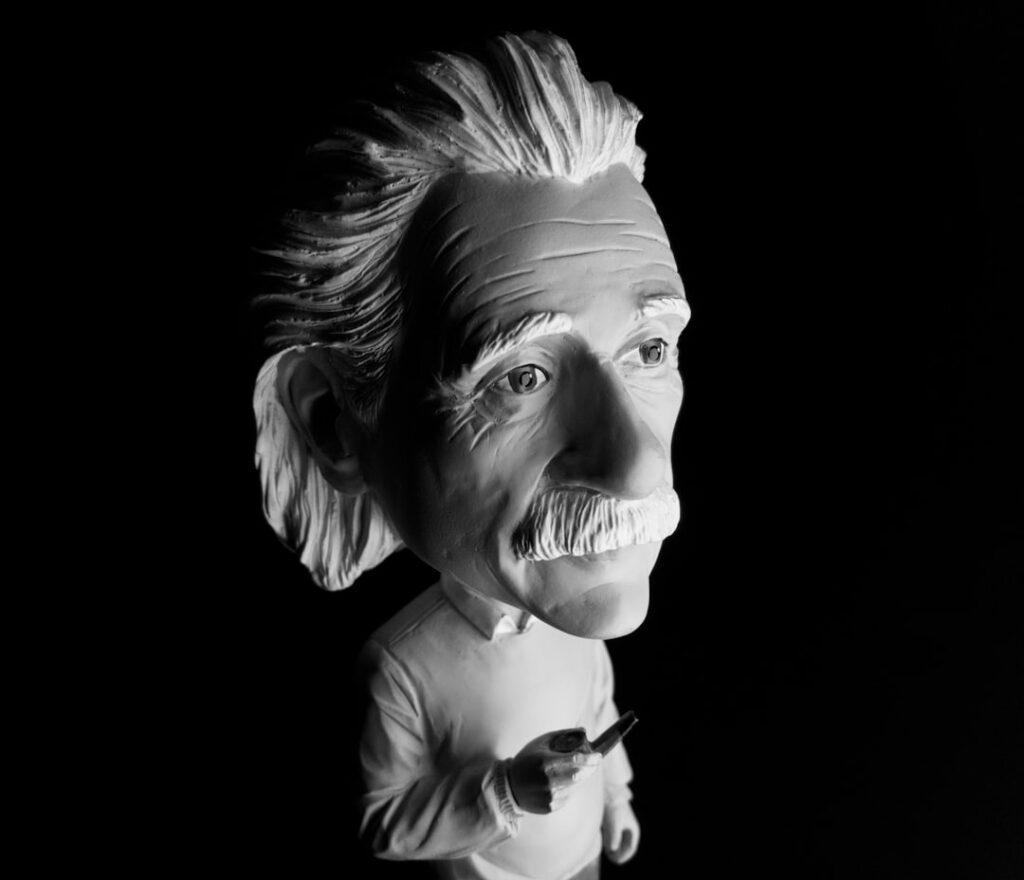
Einstein’s image transcended academia; he became an icon of popular culture during his lifetime and continues to be celebrated today. His distinctive appearance—characterized by wild hair and expressive facial features—has made him instantly recognizable worldwide. Beyond visual representation, Einstein’s name has become synonymous with genius itself.
His contributions have inspired countless works across various media forms including literature, film, music, and art. From biographical films like “Genius” to references in songs by artists such as Bob Dylan or The Beatles—Einstein’s influence permeates popular culture while serving as a reminder of human creativity’s potential.
Einstein’s Lasting Legacy
Albert Einstein’s legacy endures through both his scientific achievements and humanitarian efforts; he remains one of history’s most celebrated figures whose ideas continue shaping our understanding of reality today. His theories revolutionized physics while challenging conventional wisdom about space-time relationships—paving pathways for future discoveries within science. Moreover, Einstein’s commitment to social justice resonates strongly within contemporary discussions surrounding ethics in science—encouraging future generations not only to pursue knowledge but also advocate for positive change within society at large.
As we reflect upon his life’s work—both scientific breakthroughs alongside moral convictions—it becomes clear that Albert Einstein’s impact will be felt for generations yet to come.
In addition to Walter Isaacson’s insightful biography, “The Life of Albert Einstein,” readers may find the article on Hellread titled “Hello World” to be a fascinating exploration of the impact of scientific advancements on modern society. This article delves into how figures like Einstein have shaped our understanding of the universe and influenced contemporary thought. For more information, you can read the article here.
FAQs
Who is the author of “The Life of Albert Einstein”?
Walter Isaacson is the author of “The Life of Albert Einstein.”
What is the main focus of the book “The Life of Albert Einstein”?
The book focuses on the life, scientific achievements, and personal experiences of Albert Einstein.
When was “The Life of Albert Einstein” by Walter Isaacson published?
The book was published in 2007.
Does the book cover Einstein’s scientific contributions?
Yes, the book details Einstein’s major scientific contributions, including the theory of relativity and his work on quantum mechanics.
Is “The Life of Albert Einstein” a biography or a scientific text?
It is a biography that combines both Einstein’s personal life and his scientific work.
Does the book discuss Einstein’s early life and education?
Yes, the book covers Einstein’s childhood, education, and formative years.
Are Einstein’s personal relationships explored in the book?
Yes, the book explores Einstein’s family life, marriages, and friendships.
Does the biography include Einstein’s political and social views?
Yes, the book discusses Einstein’s political activism and social beliefs.
Is “The Life of Albert Einstein” suitable for readers without a scientific background?
Yes, Walter Isaacson writes in an accessible style that is suitable for general readers.
Does the book include any previously unpublished information or letters?
The biography includes extensive research and some insights from letters and documents that provide a deeper understanding of Einstein’s life.




