
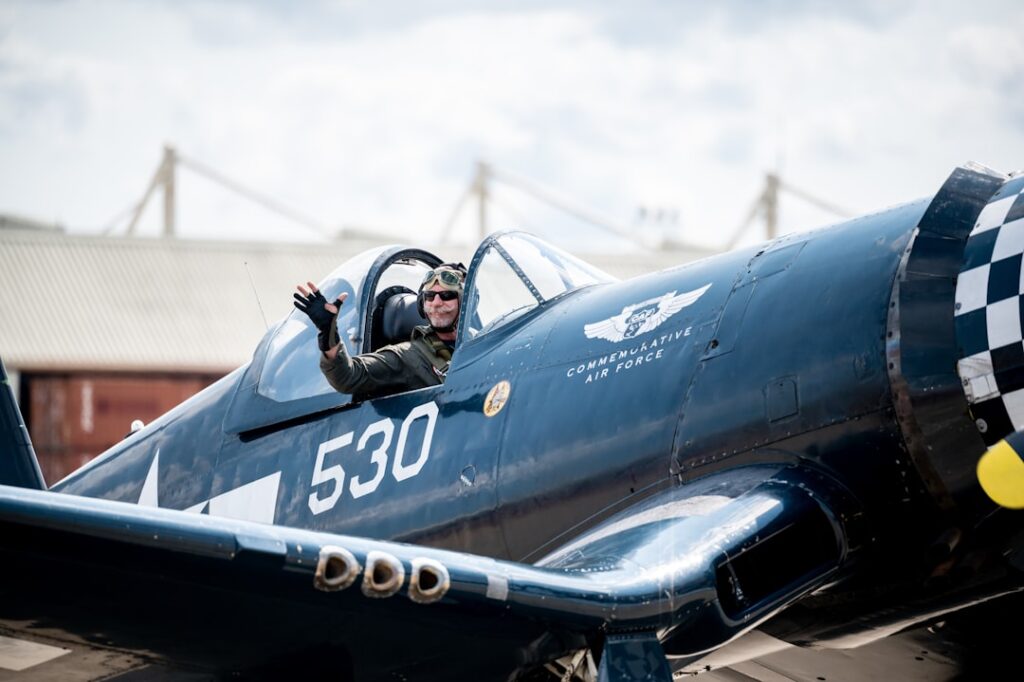
The F4U Corsair, a fighter aircraft that emerged during World War II, is often celebrated for its distinctive design and remarkable performance. Developed by Vought Aircraft, the Corsair was characterized by its unique inverted gull wing, which not only contributed to its aerodynamic efficiency but also allowed for a larger propeller diameter. This design feature was crucial in enhancing the aircraft’s speed and maneuverability, making it a formidable opponent in aerial combat.
The Corsair was primarily used by the United States Navy and Marine Corps, and it quickly gained a reputation for its exceptional capabilities in both air-to-air and air-to-ground engagements. The aircraft’s development was driven by the need for a high-performance fighter that could operate from aircraft carriers in the Pacific Theater. The F4U Corsair was powered by the Pratt & Whitney R-2800 Double Wasp engine, which provided it with impressive horsepower and speed.
With a top speed exceeding 400 miles per hour, the Corsair was one of the fastest piston-engine fighters of its time. Its armament included six .50 caliber machine guns and the capability to carry bombs and rockets, making it versatile for various combat scenarios. The combination of speed, firepower, and agility solidified the F4U Corsair’s status as one of the most iconic aircraft of World War
Key Takeaways
- The F4U Corsair was a legendary fighter aircraft used in World War II, known for its distinctive gull-wing design and powerful performance.
- Test pilots played a crucial role in the development of aircraft, ensuring their safety and performance before they were put into service.
- Boone Guyton was a renowned test pilot who made significant contributions to the development and testing of the F4U Corsair.
- The F4U Corsair earned the nickname “Whistling Death” due to the sound produced by its wing root at high speeds, and it became a feared and respected aircraft in the Pacific theater.
- Test flying the F4U Corsair presented numerous challenges, including handling issues and landing difficulties, which required skilled pilots like Boone Guyton to overcome.
The Test Pilot’s Role in Aircraft Development
Test pilots play a critical role in the development of new aircraft, serving as the bridge between engineering concepts and operational realities. Their responsibilities extend beyond mere flight; they are tasked with evaluating an aircraft’s performance, handling characteristics, and safety features. This requires a deep understanding of aerodynamics, engineering principles, and the specific mission profiles for which the aircraft is designed.
Test pilots must be able to provide detailed feedback to engineers, identifying any issues or areas for improvement based on their firsthand experience in the cockpit. The process of test flying is inherently risky, as pilots often operate prototypes that may not have undergone extensive safety testing. They must be prepared to handle unexpected situations, such as mechanical failures or adverse weather conditions.
A successful test pilot must possess not only technical skills but also a strong sense of judgment and adaptability. Their insights can lead to significant design modifications that enhance an aircraft’s performance and safety, ultimately influencing its success in military or civilian operations. The contributions of test pilots are invaluable, as they ensure that new aircraft meet the rigorous demands of their intended use.
Boone Guyton: A Brief Biography
Boone Guyton was a prominent figure in aviation history, known for his exceptional skills as a test pilot and his contributions to the development of several iconic aircraft, including the F4U Corsair. Born in 1915 in North Carolina, Guyton developed an early fascination with flight that would shape his future career. After earning his pilot’s license at a young age, he joined the United States Navy, where he honed his flying skills and gained valuable experience that would later serve him well as a test pilot.
Guyton’s career took off during World War II when he became involved in testing various military aircraft. His expertise and calm demeanor under pressure made him an ideal candidate for test flying the F4U Corsair. Throughout his career, he demonstrated an unwavering commitment to aviation safety and innovation.
Guyton’s contributions extended beyond just flying; he played a pivotal role in providing feedback to engineers that led to critical design improvements in the Corsair and other aircraft. His legacy as a test pilot is marked by his dedication to advancing aviation technology and ensuring the safety of future generations of pilots.
The Whistling Death: Origins of the F4U Corsair
The nickname “Whistling Death” was bestowed upon the F4U Corsair due to the distinctive sound produced by its powerful engine and propeller configuration during flight. This moniker not only captured the attention of those who heard it but also instilled fear in enemy pilots who faced this formidable aircraft in combat. The origins of the F4U Corsair can be traced back to the early 1930s when Vought Aircraft began exploring designs for a new naval fighter that could outperform existing models.
The design process was marked by innovation and experimentation. Engineers sought to create an aircraft that could excel in speed, agility, and firepower while maintaining the ability to operate from aircraft carriers. The inverted gull wing design was a groundbreaking feature that allowed for improved aerodynamics and stability at high speeds.
As prototypes were developed and tested, it became clear that the Corsair had the potential to revolutionize naval aviation. The combination of its unique design and powerful engine resulted in an aircraft that would soon become a game-changer in aerial warfare.
The Challenges of Test Flying the F4U Corsair
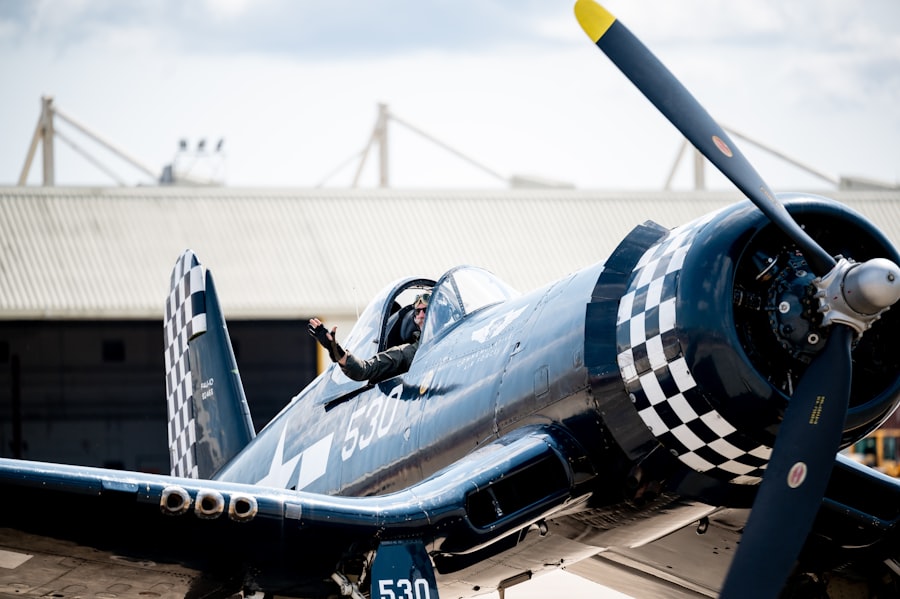
Test flying the F4U Corsair presented numerous challenges that required skillful navigation and quick decision-making from pilots like Boone Guyton. One of the primary concerns during initial flights was the aircraft’s tendency to stall at low speeds, particularly during landing approaches. This issue was exacerbated by the Corsair’s long nose, which made visibility difficult for pilots during landing maneuvers.
Test pilots had to develop specific techniques to manage these challenges effectively while ensuring their own safety. Another significant challenge was related to the Corsair’s landing gear configuration. The aircraft’s unique design necessitated a different approach to landing than traditional fighters.
Test pilots had to adapt their techniques to account for the aircraft’s characteristics, including its high speed and heavy weight. Additionally, there were concerns about structural integrity during high-speed maneuvers, which required careful monitoring during test flights. Despite these challenges, Guyton and his fellow test pilots provided invaluable feedback that led to modifications enhancing both performance and safety.
The Impact of the F4U Corsair in World War II
The F4U Corsair made a profound impact during World War II, particularly in the Pacific Theater where it served as a key asset for U.S. forces. Its combination of speed, firepower, and agility allowed it to dominate enemy aircraft in dogfights while also providing effective ground support through bombing runs and rocket attacks.
The Corsair quickly established itself as one of the most successful fighter planes of the war, achieving an impressive kill-to-loss ratio that underscored its effectiveness in combat. The aircraft’s operational success can be attributed not only to its design but also to the skilled pilots who flew it. Marine Corps aviators embraced the Corsair for its performance capabilities, often engaging in fierce aerial battles against Japanese fighters such as the A6M Zero.
The Corsair’s ability to outmaneuver many enemy aircraft gave U.S. forces a significant advantage in air superiority missions. Furthermore, its rugged construction allowed it to withstand damage better than many contemporaries, enabling pilots to return safely even after sustaining hits.
Boone Guyton’s Experience Test Flying the F4U Corsair
Boone Guyton’s experience as a test pilot for the F4U Corsair was marked by both challenges and triumphs that would shape his legacy in aviation history. As one of the first pilots to fly this groundbreaking aircraft, Guyton faced numerous hurdles during initial test flights. He quickly learned how to manage the unique characteristics of the Corsair, including its stall tendencies and landing gear configuration.
His ability to adapt and provide constructive feedback was instrumental in refining the aircraft’s design before it entered full production. Guyton’s contributions extended beyond technical evaluations; he also played a vital role in fostering a culture of safety among test pilots. His emphasis on thorough pre-flight checks and risk assessment helped establish best practices that would benefit future generations of aviators.
Through his experiences flying the Corsair, Guyton not only contributed to its development but also set a standard for professionalism within the field of test piloting.
The Legacy of the F4U Corsair
The legacy of the F4U Corsair endures long after its final flight during World War
Its innovative design and exceptional performance have left an indelible mark on aviation history, influencing subsequent generations of fighter aircraft. The Corsair’s unique features have been studied extensively by engineers and designers seeking to understand what made it so successful in combat situations. Its impact on naval aviation is still felt today, as many modern fighter jets incorporate elements inspired by its design principles.
Moreover, the F4U Corsair has become an enduring symbol of American military aviation prowess. Its storied history has been immortalized in films, documentaries, and literature, capturing the imagination of aviation enthusiasts around the world. The aircraft is celebrated not only for its combat achievements but also for its role in shaping naval tactics and strategies during World War
The Significance of “Whistling Death” in Aviation History
The nickname “Whistling Death” holds significant meaning within aviation history, encapsulating both the fear it instilled in adversaries and its remarkable capabilities as a fighter aircraft. This moniker reflects not only the sound produced by its powerful engine but also symbolizes the effectiveness of U.S. naval aviation during World War
Furthermore, “Whistling Death” serves as a reminder of how technological advancements can alter the course of warfare.
Its legacy continues to resonate today as modern fighter jets draw inspiration from its design elements and performance characteristics.
The Technical Specifications of the F4U Corsair
The technical specifications of the F4U Corsair highlight its status as one of the most advanced fighter aircraft of its time. Powered by a Pratt & Whitney R-2800 Double Wasp engine, it produced 2,000 horsepower, enabling it to reach speeds exceeding 400 miles per hour at altitude. The aircraft had a wingspan of 40 feet 11 inches and an overall length of 33 feet 4 inches, with an empty weight of approximately 8,600 pounds.
Armament was another key aspect of the Corsair’s design; it typically carried six .50 caliber M2 Browning machine guns mounted in its wings along with provisions for bombs or rockets under its wings for ground attack missions. The combination of speed, firepower, and agility made it highly effective against both enemy fighters and ground targets alike. Additionally, its range was approximately 1,000 miles with drop tanks installed, allowing it to conduct long-range missions without refueling.
The Enduring Story of the F4U Corsair and Boone Guyton
The story of the F4U Corsair is intertwined with that of Boone Guyton, whose contributions as a test pilot were instrumental in bringing this iconic aircraft to life. Together, they represent a significant chapter in aviation history marked by innovation, bravery, and excellence in engineering. The legacy of both continues to inspire future generations within aviation circles while serving as a testament to human ingenuity in overcoming challenges through collaboration between engineers and skilled pilots.
As we reflect on this enduring story, it becomes clear that both the F4U Corsair and Boone Guyton have left an indelible mark on military aviation history—one defined by remarkable achievements against adversity and an unwavering commitment to excellence that resonates even today.
In “Whistling Death: The Test Pilot’s Story of the F4U Corsair,” Boone Guyton provides an in-depth look at the development and testing of the iconic fighter aircraft. For those interested in further exploring the world of aviation history and the stories of test pilots, an article on Hellread offers additional insights. You can read more about similar topics in aviation by visiting this related article on Hellread. This piece delves into the experiences and challenges faced by test pilots, providing a broader context to the daring and innovative spirit that defined the era of the F4U Corsair.
FAQs
What is the F4U Corsair?
The F4U Corsair is a fighter aircraft that was used extensively during World War II and the Korean War. It was known for its distinctive gull-wing design and excellent performance.
Who was Boone Guyton?
Boone Guyton was a test pilot who played a crucial role in the development and testing of the F4U Corsair. He was known for his exceptional flying skills and his contributions to the aircraft’s success.
What is “Whistling Death”?
“Whistling Death” was the nickname given to the F4U Corsair by the Japanese due to the distinctive sound it made during high-speed dives. The aircraft’s powerful engine and unique design made it a formidable opponent in combat.
What can readers expect from the book “Whistling Death: The Test Pilot’s Story of the F4U Corsair”?
The book provides a firsthand account of the F4U Corsair’s development and testing from the perspective of test pilot Boone Guyton. It offers insights into the challenges and triumphs of the aircraft’s early days and its impact on military aviation.




