

Thomas Jefferson was born on April 13, 1743, in colonial Virginia, specifically at the Shadwell plantation, which was part of the larger Albemarle County. He was the third of ten children in a family that belonged to the planter class, which afforded him a comfortable upbringing. His father, Peter Jefferson, was a successful landowner and surveyor, while his mother, Jane Randolph, came from a prominent Virginia family.
This environment provided Jefferson with access to education and resources that would shape his intellectual pursuits. From a young age, he exhibited a keen interest in reading and learning, often immersing himself in the works of classical philosophers and contemporary thinkers. Jefferson’s formal education began at a local school before he attended the College of William & Mary in Williamsburg at the age of 17.
There, he studied a wide array of subjects, including philosophy, mathematics, and law. His time at the college was marked by an insatiable curiosity and a desire to engage with Enlightenment ideas. He was particularly influenced by the works of John Locke and other Enlightenment philosophers who emphasized reason, individual rights, and the social contract.
Jefferson graduated in 1762 and began studying law under George Wythe, one of Virginia’s most respected legal minds. This legal training would later prove invaluable as he navigated the complexities of governance and law throughout his career.
Key Takeaways
- Thomas Jefferson was born in Virginia in 1743 and received a classical education at the College of William and Mary.
- Jefferson’s political career included serving as the Governor of Virginia, Minister to France, Secretary of State, and Vice President under John Adams.
- Jefferson is best known for writing the Declaration of Independence, which outlined the principles of liberty and equality that the United States was founded upon.
- As the third President of the United States, Jefferson’s achievements included the Louisiana Purchase, the Lewis and Clark Expedition, and the establishment of the University of Virginia.
- Jefferson’s personal life was marked by his marriage to Martha Wayles Skelton and his ownership of enslaved individuals, which has been a source of controversy and criticism.
Political Career and Contributions
Jefferson’s political career began in earnest in the 1760s when he became involved in the growing resistance against British colonial rule. He was elected to the Virginia House of Burgesses in 1769, where he quickly established himself as a vocal advocate for colonial rights. His early political writings, including “A Summary View of the Rights of British America,” articulated the grievances of the colonies and laid the groundwork for future revolutionary thought.
Jefferson’s ability to articulate the aspirations of his fellow colonists made him a prominent figure in the movement toward independence.
He was appointed as a delegate to the Continental Congress in 1775, where he joined other leaders in discussing strategies for resistance.
His contributions during this period were pivotal; he was instrumental in drafting key documents that articulated the colonies’ desire for self-governance. Jefferson’s political philosophy emphasized liberty and equality, principles that would resonate throughout his career and influence the formation of American democracy.
Author of the Declaration of Independence
In 1776, Jefferson was tasked with drafting the Declaration of Independence, a document that would become one of the most important texts in American history. The Continental Congress sought a clear and compelling statement that justified their break from British rule. Jefferson’s eloquent prose and philosophical insights culminated in a declaration that not only outlined the colonies’ grievances but also articulated fundamental principles of human rights.
The famous phrase “life, liberty, and the pursuit of happiness” encapsulated Enlightenment ideals and resonated deeply with the American populace. The drafting process was not without its challenges. Jefferson faced scrutiny from fellow delegates who sought to modify certain sections of his work, particularly those addressing slavery.
Despite these tensions, Jefferson’s vision prevailed, and the Declaration was adopted on July 4, 1776. The document served as a rallying cry for revolutionaries and laid the foundation for American identity. Its impact extended beyond the immediate context of independence; it inspired movements for freedom and equality around the world, influencing revolutions in France and Latin America.
Presidency and Achievements
Jefferson’s presidency began in 1801 after a contentious election that marked a significant shift in American politics. As a member of the Democratic-Republican Party, he championed agrarianism and states’ rights, contrasting sharply with the Federalist policies of his predecessors. One of his most notable achievements during his presidency was the Louisiana Purchase in 1803, which doubled the size of the United States and opened vast territories for exploration and settlement.
This acquisition not only expanded American land but also reinforced Jefferson’s vision of an agrarian republic where independent farmers could thrive. In addition to territorial expansion, Jefferson’s presidency was marked by significant domestic reforms. He sought to reduce the national debt and eliminate internal taxes, believing that a smaller government would better serve the interests of its citizens.
His administration also emphasized education and scientific inquiry; he founded institutions such as the University of Virginia, which reflected his commitment to enlightenment ideals. However, his presidency was not without challenges; tensions with Britain and France led to conflicts that tested his diplomatic skills.
Personal Life and Family
Jefferson’s personal life was as complex as his political career. He married Martha Wayles Skelton in 1772, and together they had six children, though only two survived to adulthood. Martha’s death in 1782 profoundly affected Jefferson; he never remarried but maintained close relationships with his daughters, particularly Patsy and Polly.
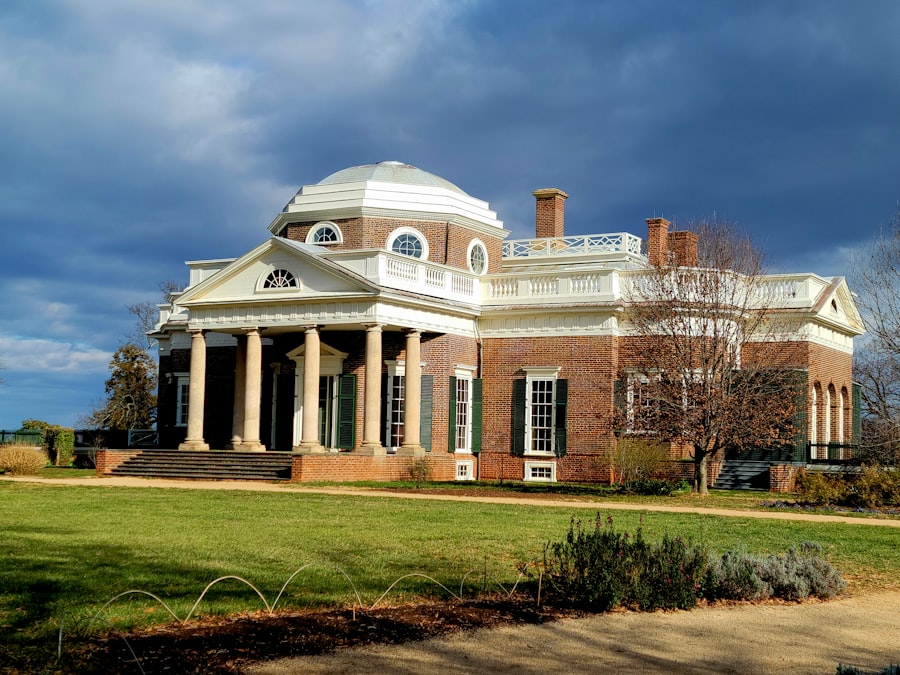
His family life was intertwined with his public persona; Jefferson often sought solace at Monticello, his beloved plantation home in Virginia, where he engaged in agricultural pursuits and intellectual endeavors. Despite his public advocacy for liberty and equality, Jefferson’s personal life was marked by contradictions. He owned numerous slaves throughout his life, which has led to significant scrutiny regarding his legacy.
His relationship with Sally Hemings, an enslaved woman at Monticello who was believed to be his concubine and mother to several of his children, further complicates his narrative. This aspect of his life raises questions about the intersection of personal beliefs and societal practices during a time when slavery was deeply entrenched in American society.
Legacy and Impact on American History

Jefferson’s legacy is multifaceted; he is celebrated as a Founding Father who championed individual rights and democratic principles while simultaneously criticized for his role in perpetuating slavery. The Declaration of Independence remains a cornerstone of American democracy, inspiring generations to advocate for civil rights and social justice. His vision for an agrarian republic influenced American political thought well into the 19th century, shaping debates about land use, governance, and individual liberties.
Moreover, Jefferson’s commitment to education and scientific inquiry laid the groundwork for future advancements in these fields. The establishment of the University of Virginia reflected his belief that an educated citizenry was essential for a functioning democracy. His contributions to architecture, philosophy, and governance continue to resonate today; many view him as a symbol of Enlightenment ideals that prioritize reason and human rights.
Controversies and Criticisms
Despite his many contributions to American society, Jefferson’s legacy is not without controversy. His ownership of slaves has sparked intense debate among historians and scholars regarding the moral implications of his actions versus his philosophical beliefs about liberty and equality. Critics argue that Jefferson’s failure to address slavery within his own life undermines his credibility as an advocate for human rights.
The existence of children he fathered with Sally Hemings adds another layer to this complex narrative. Additionally, Jefferson’s political decisions during his presidency have faced scrutiny. His approach to foreign policy, particularly regarding relations with France and Britain, has been criticized for its inconsistencies.
The Embargo Act of 1807 aimed to protect American interests but ultimately harmed the economy and led to widespread discontent among merchants and traders. These controversies highlight the complexities inherent in Jefferson’s character; he was both a visionary leader and a man whose actions often contradicted his ideals.
Lasting Influence and Memorials
Thomas Jefferson’s influence extends far beyond his lifetime; he is commemorated through numerous memorials and institutions that honor his contributions to American history. The Thomas Jefferson Memorial in Washington D.C., dedicated in 1943, stands as a testament to his enduring legacy as a champion of democracy and individual rights. The memorial features inscriptions from his writings that reflect his philosophical beliefs about liberty and governance.
Educational institutions named after Jefferson continue to promote his ideals through scholarship and research. The University of Virginia remains one of the premier public universities in America, embodying Jefferson’s vision for higher education accessible to all citizens. Furthermore, Jefferson’s writings continue to be studied extensively; they serve as foundational texts for discussions on civil rights, governance, and ethical leadership.
In contemporary discourse, Jefferson’s life prompts ongoing discussions about race, equality, and historical memory. As society grapples with its past, Jefferson’s legacy serves as both an inspiration for progress and a reminder of the complexities inherent in America’s journey toward fulfilling its founding ideals. His contributions to philosophy, governance, and education remain integral to understanding not only American history but also the broader narrative of human rights across the globe.
In exploring the intricate details of Thomas Jefferson’s life as presented in “The Life of Thomas Jefferson” by Henry S. Randall, readers may find it enriching to delve into related discussions and analyses. A particularly insightful article that complements Randall’s work can be found on Hellread, which offers a broader perspective on historical narratives and their modern interpretations. For those interested in further expanding their understanding of Jefferson’s legacy and its contemporary relevance, I recommend reading this article:


