

The concept of virtual reality (VR) can be traced back to the mid-20th century, when pioneers began to explore the possibilities of immersive experiences through technology. One of the earliest examples is the Sensorama, developed by Morton Heilig in 1962. This multi-sensory machine combined 3D visuals, sound, vibrations, and even scents to create an engaging experience for users.
Although it was not a true VR system by today’s standards, the Sensorama laid the groundwork for future developments in immersive technology. Heilig’s vision was to create a “theater for the mind,” and while his invention did not achieve commercial success, it sparked interest in the potential of virtual environments. In the following decades, various attempts were made to create more sophisticated VR systems.
In 1984, Jaron Lanier founded VPL Research, which became one of the first companies to sell VR products, including data gloves and head-mounted displays (HMDs). These innovations allowed users to interact with virtual environments in ways that were previously unimaginable. However, despite the excitement surrounding these early developments, VR technology faced significant limitations due to the lack of processing power and graphical capabilities.
The high costs associated with VR systems also hindered widespread adoption, relegating them to niche markets and research institutions.
Key Takeaways
- Virtual reality technology has been around since the 1950s, but it wasn’t until the 1990s that it started gaining popularity.
- Oculus, founded in 2012, played a significant role in bringing virtual reality to the mainstream with its innovative headsets.
- Facebook’s acquisition of Oculus in 2014 for billion signaled a major shift in the virtual reality industry and brought more attention to the technology.
- Virtual reality has the potential to revolutionize various industries, including healthcare, education, and entertainment, by offering immersive and interactive experiences.
- The future of virtual reality technology is promising, with advancements in hardware, software, and content creation, paving the way for more widespread adoption and integration into everyday life.
The Emergence of Oculus
The modern era of virtual reality began to take shape with the emergence of Oculus VR, a company founded by Palmer Luckey in 2012. Luckey’s vision was to create an affordable and accessible VR headset that could deliver an immersive experience to consumers. The Oculus Rift was born out of a successful Kickstarter campaign that raised nearly $2.5 million, far exceeding its initial goal.
This funding allowed Oculus to develop a prototype that showcased the potential of VR technology, capturing the attention of gamers and tech enthusiasts alike. The Rift’s design featured a wide field of view, low latency, and high-resolution displays, which set it apart from earlier VR systems. Oculus’s success was not merely due to its innovative hardware; it also fostered a vibrant ecosystem of developers and content creators.
The company encouraged third-party developers to create games and applications for the Rift, leading to a surge in VR content that appealed to a wide audience. Titles like “Lucky’s Tale” and “EVE: Valkyrie” demonstrated the immersive potential of VR gaming, while other applications explored education, training, and social interaction. This focus on content creation helped establish Oculus as a leader in the burgeoning VR market and laid the foundation for future advancements in the field.
Facebook’s Acquisition of Oculus

In March 2014, Facebook announced its acquisition of Oculus VR for approximately $2 billion. This move sent shockwaves through the tech industry, as it signaled a significant endorsement of virtual reality by one of the largest social media platforms in the world. Mark Zuckerberg articulated his vision for VR as a new communication platform that could connect people in ways that traditional social media could not.
He believed that virtual reality had the potential to revolutionize social interaction, allowing users to engage with one another in immersive environments rather than through screens. The acquisition also provided Oculus with the resources and infrastructure needed to accelerate its development efforts. Facebook’s backing enabled Oculus to invest heavily in research and development, leading to improvements in hardware and software capabilities.
The company released several iterations of the Rift headset, each offering enhanced performance and features. Additionally, Facebook’s vast user base opened up new opportunities for social applications within virtual reality, such as Facebook Spaces, which allowed users to interact with friends in a virtual setting. This integration of social media into VR experiences marked a pivotal moment in the evolution of both technologies.
The Impact of Virtual Reality on Society
Virtual reality has begun to permeate various aspects of society, influencing fields such as education, healthcare, and entertainment. In education, VR has emerged as a powerful tool for immersive learning experiences. For instance, students can take virtual field trips to historical sites or explore complex scientific concepts through interactive simulations.
Programs like Google Expeditions allow educators to guide students through virtual environments, enhancing engagement and understanding. This application of VR not only makes learning more interactive but also provides access to experiences that may be logistically or financially prohibitive in the real world. In healthcare, virtual reality is being utilized for training medical professionals and treating patients.
Surgeons can practice complex procedures in a risk-free environment using VR simulations, honing their skills before operating on real patients. Moreover, VR has shown promise in therapeutic settings; for example, exposure therapy for phobias can be conducted in controlled virtual environments where patients confront their fears gradually. Studies have indicated that VR can reduce anxiety and improve outcomes for patients undergoing treatment for conditions such as PTSD.
As these applications continue to evolve, the societal impact of virtual reality will likely expand further into various domains.
The Evolution of Virtual Reality Technology
The evolution of virtual reality technology has been marked by rapid advancements in hardware and software capabilities. Early VR systems were often bulky and cumbersome, requiring extensive setup and specialized equipment. However, recent developments have led to more compact and user-friendly devices.
These advancements have democratized access to virtual reality experiences, allowing users from diverse backgrounds to engage with the technology. Moreover, improvements in graphics processing units (GPUs) and display technologies have significantly enhanced the visual fidelity of VR experiences.
High-resolution displays with faster refresh rates reduce motion sickness and create more lifelike environments. Additionally, advancements in tracking technology have improved user interactions within virtual spaces. Inside-out tracking systems allow headsets to monitor their position relative to the environment without external sensors, simplifying setup and increasing portability.
As these technologies continue to evolve, they will enable even more immersive and realistic experiences that push the boundaries of what is possible within virtual reality.
The Cultural and Artistic Influence of Virtual Reality
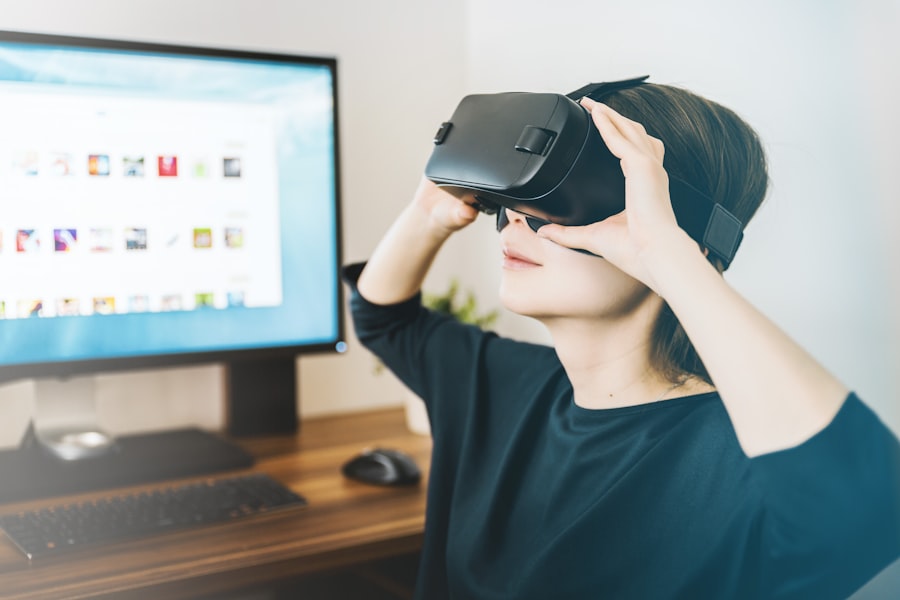
Virtual reality has emerged as a new medium for artistic expression and cultural exploration. Artists are increasingly using VR to create immersive installations that engage audiences in novel ways. For example, projects like “The Night Cafe,” inspired by Vincent van Gogh’s work, allow users to step into a 3D recreation of the artist’s iconic paintings, providing an interactive experience that transcends traditional art forms.
This blending of art and technology invites viewers to engage with creative works on a deeper level, fostering a sense of presence that is unique to virtual reality. Moreover, VR has become a platform for storytelling that challenges conventional narrative structures. Filmmakers are experimenting with 360-degree video and interactive storytelling techniques that allow viewers to influence the direction of the narrative.
Projects like “Wolves in the Walls” demonstrate how VR can create emotionally resonant experiences by placing users at the center of the story. This shift towards immersive storytelling not only expands the possibilities for artists but also encourages audiences to participate actively in their experiences rather than passively consuming content.
The Business and Economic Implications of Virtual Reality
The rise of virtual reality has significant implications for various industries and economies worldwide. As companies recognize the potential of VR technology, investments in hardware development, software creation, and content production have surged. The gaming industry has been one of the primary beneficiaries; major game developers are allocating resources toward creating VR titles that cater to an increasingly enthusiastic audience.
This shift has led to new revenue streams and business models centered around virtual reality experiences. Beyond gaming, industries such as real estate are leveraging VR for property tours and marketing purposes. Potential buyers can explore homes remotely through immersive virtual tours, streamlining the buying process and expanding market reach.
Similarly, businesses are utilizing VR for training purposes; companies can simulate real-world scenarios for employees without incurring costs associated with traditional training methods. As these applications proliferate across sectors, they contribute to economic growth while reshaping how businesses operate.
The Future of Virtual Reality
Looking ahead, the future of virtual reality appears promising yet complex as technology continues to advance at an unprecedented pace. One area poised for growth is social interaction within virtual environments; as more people seek meaningful connections online, platforms that facilitate social engagement through VR will likely gain traction. Innovations such as haptic feedback devices may enhance these interactions by providing users with tactile sensations that mimic real-world touch.
Furthermore, as artificial intelligence (AI) becomes increasingly integrated into virtual reality experiences, we may see more personalized and adaptive environments tailored to individual preferences and behaviors. AI-driven avatars could enhance social interactions by mimicking human-like responses or adapting narratives based on user choices in storytelling applications. However, challenges remain regarding privacy concerns and ethical considerations surrounding data collection within virtual environments.
In conclusion, while the trajectory of virtual reality is still unfolding, its potential impact on society is undeniable. From transforming education and healthcare to reshaping artistic expression and business practices, VR stands at the forefront of technological innovation with far-reaching implications for our future interactions with digital content and each other.
If you’re interested in exploring more about the future of virtual reality and technology, you may want to check out this article on hellread.com. It delves into the latest advancements in VR and how it is shaping our world. The History of the Future: Oculus, Facebook, and the Revolution That Swept Virtual Reality by Blake J. Harris provides a comprehensive look at the evolution of VR technology and its impact on society. Reading this book alongside the insights from the article can give you a well-rounded understanding of the potential future of virtual reality.
FAQs
What is the history of Oculus and virtual reality?
Oculus is a company that was founded in 2012 by Palmer Luckey, Brendan Iribe, Nate Mitchell, and Michael Antonov. It gained attention for its virtual reality headset, the Oculus Rift, which was initially funded through a Kickstarter campaign. The company was later acquired by Facebook in 2014.
How did Facebook become involved in virtual reality?
Facebook acquired Oculus for $2 billion in 2014, signaling its interest in the potential of virtual reality technology. This acquisition was seen as a major milestone in the development of virtual reality and its potential applications beyond gaming.
What impact did the acquisition of Oculus by Facebook have on the virtual reality industry?
The acquisition of Oculus by Facebook brought significant attention and resources to the virtual reality industry. It also sparked a wave of investment and development in virtual reality technology, leading to the creation of new VR experiences and applications.
What revolution swept virtual reality?
The revolution that swept virtual reality was characterized by the growing interest and investment in VR technology, as well as the development of new applications and experiences beyond gaming. This revolution was fueled in part by the acquisition of Oculus by Facebook and the subsequent influx of resources into the VR industry.
What are some key developments in the history of virtual reality?
Some key developments in the history of virtual reality include the founding of Oculus and the development of the Oculus Rift headset, the acquisition of Oculus by Facebook, and the subsequent growth and evolution of the virtual reality industry. These developments have helped to shape the current landscape of VR technology and its potential future applications.




